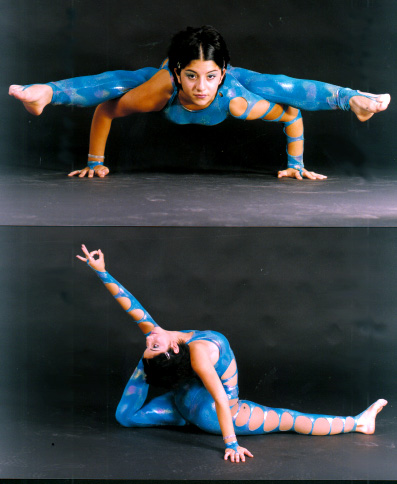
Yoga on the Net

At one time it seemed that yoga was little more than a dated hippie fad, rather like the lava lamp. But now this ancient health system is back in vogue.

Celebrities such as Gwyneth Paltrow, Madonna, and Julia Roberts and Sting are not shy about advocating the mental and physical benefits of the discipline.

It is cool to carry around a little purple mat and tie yourself up in knots in local gyms and draughty church halls. It seems yoga is everywhere, and nowhere is it more omnipresent than on the net. 

Should you wish to learn more about Sting's views on the subject, for instance, you might care to read the in-depth interview available at the White Lotus website.

You'll find a glossily professional web page which features authoritative articles on the many different forms of yoga - and the debate about which is the best.

You can also access a shop selling books and videos, or click through selection of celebrity interviews.

Share the well-illustrated interview with Sting, in which he expresses regret at not having started yoga earlier. But he adds that, if anything, the exercise seems to be reversing the ageing process.

This view is echoed by fellow megastar Madonna. Indeed, the title song, Ray Of Light, in her best-selling album incorporates a traditional yoga chant.

If you are moved to discover more details, Roots And Wings, a 'yoga, bodywork and natural healing centre' will be happy to provide you with the original Sanskrit text of that chant.

Roots And Wings is largely geared to selling yoga products, but you'll also find articles, discussion groups and a search engine for locating those all important Sanskrit lyrics (just type in Madonna).

Another site, called Evolution, describes itself as an online yoga magazine, and although it can be a little graphic-heavy and slow, it's a snazzy and informative creation.

The visitor is offered enticements such as a free email newsletter, meditation advice, chants and even recipes.

Should you find Evolution's animated yoga girl icon annoyingly limber, you might be tempted to compete with her by practising a selection of yoga postures yourself.

Evolution allows you to call up these postures on your screen.

It seems that cyberspace is not yet the proper place to learn the subtleties of this ancient discipline: for that you'll still need to take a traditional class with a teacher.

The size of the waist is an indication of overall fitness for many people. Most health experts agree that a smaller waist is healthier than a big one. The reasoning behind this is that increases in fat around the waist usually result in increased health risks such as diabetes, high cholesterol and blood pressure.

In evolutionary and biological terms, a small waist signifies youth and vitality. But doing endless workouts of crunches alone will not allow you to achieve that Venus-like waist of your dreams. You will need to supplement specific waist-orientated exercises with ones from various disciplines.

Specifically you will need to work the inner girdle of muscles - commonly known as the core muscles - with slow abdominal exercises that work very deep into these muscle groups.

While usually associated with building flexibility, some specific exercises from yoga-based workouts also target the underlying core muscles around the waist.

WARRIOR III POSE: Start in the Mountain Pose with the heels slightly apart, big toes touching, legs straight, chest lifted, pelvis in a neutral position. Placing hands on hips, step back with your right foot so just your right toes touch the floor, all of your body weight on your left foot. 

Keep your right leg extended in a straight line as you start to lean forward from your hips. Balance the length of your body, from your right heel to your fingertips, over your left leg until your torso is parallel to the floor. Keep your weight evenly distributed through inner and outer heel, with hips level. Begin with 5 breath cycles and progress to 15. 

Lift your torso up and return to the Mountain Pose; repeat on the other side. 

PLANK POSE, SIDE-PLANK POSE 
Begin on your hands and knees, hands directly under shoulders, knees under hips. Move feet back until the legs are straight and you're balancing on your toes, feet together. Keep the shoulders pulled back and down, arms straight. This is the Plank Pose. 

Squeezing the ankles together, roll onto the outer edge of the left foot, keeping feet stacked, legs straight. Lift the right hand toward ceiling then look up at it. Let your abs support your body without clamping and crunching. Then lower right hand to floor, rolling down toward the right, and return to the Plank Pose. Repeat on other side. Hold each pose for 5 breath cycles.

Mr. La Forge (Yoga Trainer) suspects that because the mind-body exercises typically are easier to pursue, executives have a better chance of making a lifetime habit of them. To see if his hunch is correct, he launched a five-year study of 110 middle- and upper-level executives in companies in the US. He tracks their exercise habits and see if those incorporating mind-body techniques stick with the program longer.

Devotees say the mind-body exercise regimen has a payoff in the workplace, as well.

Barry Moltz, 36, founder and CEO of CHTech International., a mail-order distributor of computer hardware and software, started doing Yoga a year ago at the to balance the pressures of growing a business with starting a family. He still works out in a gym and commutes to work on his bicycle, but he also meditates in the half-lotus position for 15 or 20 minutes at night after his two young children have gone to sleep.

He says most of his friends, also in their mid-30s, have jumped on similar mind-body fitness tracks.

''I think the toughest part about running a company is that there are so many demands on your time. When I meditate, it really allows me to relax and focus all my energies in one place,'' he says. ''Now when I'm involved in a meeting, I can be immersed in that meeting instead of thinking about 15 other things. And people really respond when you're totally focused on just them.''

The pressures of the job say you shouldn't be satisfied where you are today. You can never feel like you've achieved anything because it's very elusive. Yoga and meditation allows you to be happier and more effective in what you're doing now.

The Diamond Posture (Vajrasana) - Kneel on a thick carpet or blanket with your knees close together. Sit back on your heels and stretch up from your hips, balancing your head well so that a line drawn through ear, shoulder, elbow and hip would be straight. You should sit up in this posture for greatest benefits.

The Locust (Salabhasana)
Most yoga students are familiar with this posture. Lie flat, face down, chin on floor. Make your hands into fists and push them either under your thighs to help the lift, or place them alongside your body. Exhale and lift legs from your hips, tightening your buttocks and stretching your legs up and back. Hold position for as long as possible, exhale, return to starting posture and repeat.

he Dog Stretch (Adho mukha svanasana) 
Lie face down, legs stretched back, buttocks tightened and knees pulled back. Place hands just below shoulders, exhale and lift head, then chest, shoulders and torso, pushing down from your pelvis and straightening your arms. From the back of your head to your tailbone, your body should be curved back. Push shoulders back and down. Push head back more. Stay like this as long as possible with normal breathing. Come down very slowly, and relax.

The Twist (Bhardwajasana) 
Kneel on the floor and sit back, bringing both feet to the right of your hips. Straighten your right arm, bring it across your body and turn to the left. Place your hand, palm down under your left knee. Exhale, turn your body more to the left and clasp your right elbow with your left hand, from the back. Turn your head and gaze over your right shoulder. Fold position for a few breaths and then twist and look back over your left shoulder. Shoulders should be at right angles to the body. Come back to starting position and repeat on other side. You should do this posture once every hour if you have lower back pain.

Suresh Nigam, chairman of MetJet, one of the leading trainers of computer hardware engineers in India, not only practices yoga but preaches it at his 35 centers. 

So what is it and how does it work.

At the heart of it is something which translates as the stoppage of mind modification. For example when we hear music we get distracted. We must stay aware and conscious but not get distracted from our goal.

How then does yoga, an ancient, essentially private activity, help in the work environment. 

Suresh believes that the collective is an entity just as much as an individual is. If individuals are happy, calm and alert then the collective consciousness is harmonious and dynamic and will produce better results. If people are tense and unhappy it will reflect in their productivity.

At MetJet all managers and employees are sent to the Yoga Institute at Santa Cruz (in Mumbai) which was founded in 1989. There people are shown a path, how to control your mind and not to run after sensual pleasures. You learn not to run away from your responsibilities. 

The root cause of these afflictions is ignorance. That leads to a grandiose sense of self-importance and misunderstanding. We love and hate in extremes. By getting up and finding out what is happening, we reduce stress. Once you are aware of what is going on you have won half the battle.

There are many of us who feel we are not as bright as we would like to be; or that we lack the will power a friend or a colleague seems to have. What is not known widely - or taken with skepticism even when known - is that mental power can be enhanced by Yoga and meditation. 

Don't worry if your allopathic doctors dismiss this claim, or worse, laugh at it in contempt. Allopathic doctors tend to downplay such claims because allopathy has been brainwashed into a sort of negativism. 

While the neuro-surgeon himself swears by the mantra which he recites every morning, believing it is instrumental in making divine energy flow through him, he feels that the beneficial effects of yoga on all professionals, particularly businessmen, have hardly been talked about.

Yoga or meditation is very beneficial to business executives because it makes decision-making much easier and quicker. It takes away vacillation and helps the brain to grasp the pros and cons quickly.

A surgeon needs to take a decision quickly on the operating table. Similarly, a businessman may not have more than five minutes to decide. Supposing he has a dollar 1 million business deal where a decision has to be made in five minutes, he needs a brain which is stimulated and in a trim state. In this state, decision-making becomes easy and anxiety level goes down.

In such a state not only is the brain able to think clearly, but the other systems of the body which suffer due to stress or tensions, are also spared.

Many computer users around the world face the problem of back pain. Having your back against the wall usually means you're in trouble. But for certain yoga positions, having your back firmly against a wall will aid health.

In Hatha Yoga, the practitioner forms what Swami Gitananda calls body geometry--triangles, straight lines, circles and parallel lines. When you do a posture, always stretch your body to its utmost limit and then hold it there for a slow count of 10, gradually building up the time, until each posture can be maintained for 30 seconds. Holding a posture is essential to yoga because it gives the body a chance to settle into the stretch and loosen up. Then each time you stretch it will be just that little bit farther. 

Many of the sideways, or lateral, stretches in Hatha Yoga require that the body face forward, with hips level and back and spine tilting neither forward nor back. Beginners tend to lean forward to increase the stretch. But leaning forward is wrong and will actually detract from benefits and possibly cause harm. To perform these stretches properly, make sure to keep your spine firmly against a wall. The wall acts as a prop. Even those who have practiced yoga may find that they cannot bend as far as they thought they could when they do the postures properly. The extra time spent in forming careful postures will pay off: Your body will gain excellent flexibility and strength.

Hatha Yoga

Hatha yoga is an ancient hindu system of working with the human nervous system. Because it releases tension and endows one with renewed energy, far too many 20th century people, yoga teachers included, have come to look upon the venerable Indian physical science as solely an exercise for health and vitality of mind and body. It is that, but it is also much more. Hatha yoga practices are more spiritual than physical, more subtle than gross, more a means of understanding than an exotic way to relieve stress or limber up the body.

The sages who developed hatha yoga designed it as a way to gain conscious control of our life energies, a way to go within, to harmonize the external so the innermost Self could be encountered. To them, it was about states of consciousness, about living a divine life, and it was a preparation for meditation.

As you perform the asanas, concentrate on feeling the energies within the nerve currents. Sensitize yourself to knowing when the body has been in each position long enough to tune the nerve currents involved. Then shift smoothly into the next asana. It's like a dance, a deliberate, fluid dance. During all postures, inhale using the diaphragm, not the chest muscles. Do not stretch unduly or force the body. Relax into the poses. Don't worry if you can't perform them all perfectly. In time, you will find the body becoming more flexible and supple. Free the mind of thoughts and tensions. You will be more aware, more alive, more serene.

While there are many more complex hatha yoga routines, these twenty-four asanas provide a balanced system for daily use. For the simple purpose of quieting the mind in preparation for meditation, this is all you will ever need. For best results, hatha yoga should be taught personally by a qualified teacher. These instructions and drawings are meant only as a rudimentary aid. For more elaborate regimens, inquire at a recognized school specializing in hatha yoga.

The scene of hatha yoga has a spiritual purpose - to balance physical and physic energies in preparation for meditation. It is not only meant to make us young, beautiful or creative, but to aid us in quieting the mind, body and emotions that we may awaken enlightened consciousness & know the Self within.

Turbaned gurus, sing-song mantras and bodily contortions . . . the promise of true enlightenment and omphaloskepsis (contemplation of the naval) completes the cliche. But don't knock yoga till you've tried it, and then only with respect.

Yoga means to bind together -- variously joining sun and moon, left and right, male and female, and any number of yins and yangs -- through ascetic techniques of meditation and exercise. The goal is physical and mental balance. 

Indian Hatha' yoga is best known to Westerners. Double-jointedness isn't a prerequisite, but the classic lotus position, cross-legged on the floor, soles-up on the inner thigh, either comes naturally or doesn't.

Then there are more magical/mystical varieties of yoga for which people quit jobs and polite society and retreat to the Himalayas. But not everyone follows a spiritual guide beyond the Beltway; they'd rather take up the discipline at a local ashram or the Y.

Committed practitioners claim yoga leads to intuitive awareness, spiritual harmony, perfect concentration. Others use it to lose weight or quit smoking. Some just like the lift they get from yoga asanas (positions) better than breaking into a sweat with pushups. In any case, it can't hurt, if done in moderation and with proper guidance.

Twenty percent of all those who undergo surgery for lower back pain will get no relief. The remaining 80 percent will have problems ranging from mild to severe. All will have trouble with spinal flexion.

Yoga does not offer cures. It simply promises that if you faithfully practice these asanas every day, there will be no pain and you will build up a strong and supple spine, restructuring posture and body image. Once you have back problems you must remain conscious all through the day of how you stand, sit and lie down. Here are a few guidelines:

Always sleep on a firm (not necessarily hard) bed, with a flat pillow under your head and a thicker one under your knees. This will help the spine to reposition and adjust itself. 

Do not wear high heels as this promotes lumbar lordosis and throws the spine out of balance.

Do not go in for break-dancing, strenuous aerobics, jogging, running or anything where you need to bounce or jiggle. Guarded activity is the key here.

For lower back pain, sitting is the most painful. Sit on a firm seat, not squashy cushions, and sit on your buttock bones. Do not loll back on the tailbone or lower spine. Wedge a rolled towel or small cushion behind your back to keep you upright. Sit as often as possible in The Diamond Posture (Figure 1) in order to benefit the sciatic nerve and to cure a convex or a lateral curvature of the spine.

When the pain is acute and you can neither sit nor stand in comfort, rest in bed, take whatever anti-inflammatory or analgesic medications your physician prescribes, and wait until the pain is milder before starting on these postures.

All these asanas have healing and curative properties. They will act as a form of mild traction, gently stretching the spinal muscles in safe extension postures. Strength will be gradually built up in the paraspinal muscles and buttocks, abdominal organs will be toned and strengthened, and pressure points all along the spine will be stimulated. Practice each asana to the point where mild pain is felt.

Is it any surprise models are wrapping their wrists in mala beads, fashion designers are heading off to India for yoga retreats and there's a new line of active wear that takes its name from the Sanskrit mantra om.

To the uninitiated, yoga is pretzel-like poses and a dim memory of the Beatles visiting the Maharishi in the 1960s. 

Gurmukh Kaur, the Center for Living's white-turbaned founder, travels by limo -- in a blaze of camera strobes -- with one of her students, singer Courtney Love.

What she does is kundalini yoga, Ms. Love told a reporter covering the bash for fashion-bible Women's Wear Daily. It's better for me than Prozac -- and the clothes are nice, too.

Ms. Love is hardly the only celebrity singing the praises of yoga -- or helping to catapult the 5,000-year-old practice onto the cutting edge. 

Yoga Zone, a hip New York yoga studio with a half-hour show weekdays on cable's Health Network, has an entire catalog dedicated to the joy of yoga. In addition to the predictable range of videotapes, nonslip mats and meditation cushions, there are multiple pages of clothing and accessories.

Cotton-Lycra hipsters are the definitive Yoga Zone look for practice and beyond. Spaghetti-strap camisoles and halter tops with subtle embroidered logos come in black, slate, garnet, moss green and other quiet but current colors.

Even the jewelry has a fashion angle: Pendant necklaces with the Chinese symbol for clarity or the Sanskrit symbol for om are crafted by the hot fashion duo Me & Ro.

Mind-body fitness, which derives from Eastern philosophies and religions, improves physical and emotional well-being, and has implications for workplace performance.

The overall benefits of mind-body exercise are documented in an increasing number of scientific studies. They include everything from reducing cardiac risk factors to enhancing mood.

'You're under stress, but you have to be in control all day, and after so many years, what happens is that leads to eating misbehaviors, stress hormone production and cardiac risk factors,. The good news is you can reverse these risk factors non-pharmacologically and develop some habits for a lifetime' that complement conventional diet and exercise.

The kinder, gentler movements typical of yoga improve flexibility, strength and muscle tone and can be more youth-promoting than the wear-and-tear of daily aerobics, weights and running alone.

Especially with the baby boomer generation getting older, they're realizing the need for flexibility, the need for good posture, and the desire for the things that are going to help them look and feel young.

Stand straight against the wall and stretch the feet about three to four feet apart. Inhale and raise arms up to shoulder level, palms down. Point right foot to the right and slightly turn in left foot. Bend right knee to form a right angle, with thigh parallel to the floor and the shin vertical. The knee should be directly above the ankle. Stretch the back leg and tighten the knee.

Exhale and stretch right hand down to rest on floor behind right foot. Turn head to look up and press left hip flat against wall with left hand. A strong pull should be felt all along the left side. When you feel comfortable, stretch the left arm up and press it against your ear so that from left heel to left hand the body is stretched and extended. Hold this position for a slow count of 10, making sure that upper shoulder, hip and bent knee are pressed against the wall. Inhale and return to starting position. Exhale and repeat on left.

Benefits: This posture produces overall health. It tones every muscle, tendon and joint in the body. The heart is revitalized and strengthened, and, if crooked, the spine is stretched and realigned. The hip joints, which can weaken with age, become stronger and more flexible. The neck is stretched and made more flexible, easing the pain of stiff, tense muscles and spondylosis. Thighs, hips and waist are firmed. Even digestion is improved.

Remember to lie down and relax after your yoga practice. Relaxation after exercising helps the body to recover, regulates the flow of blood, and calms and soothes the mind. That way you don't feel tired but refreshed and invigorated.

There are actually several branches of yoga, including bhakti, the yoga of devotion, and jnana, the yoga of knowledge. The most widely practiced branch in the US, the one typically offered at gyms and exercise studios, is hatha yoga, which is physical yoga. But there also are different styles of hatha yoga, from the exercise-intense power yoga to the gentle chair poses used in svaroopa yoga.

Many of the instructors offer integral yoga, which involves stretching and bending into various positions called asanas, as well as breathing exercises and deep relaxation. By practicing and learning asanas, students can gain flexibility, strength, stamina and improved circulation.

Integral yoga is not religious, but it does offer an introspective, spiritual component that you won't find in most exercise programs.

A typical adult class lasts 1 hour. First, the students center themselves through breathing, then come together as a group with a collective om. They do a quick series of cardiovascular movements, an hour of stretching and 20 minutes of relaxation while lying on their backs.

The relaxation period gives students a chance to turn inward. Some people are making lists in their head. Some people are asleep. Some people are just in a really great space, where they're conscious of what's going on in the room, and yet at the same time, completely and unequivocally out.

For Gail Stuart, who is finishing a beginner's series, yoga is an antidote to the stress of her job at the Medical University of South Carolina, where she works with psychiatric research. You just walk through the whole process, and you feel yourself slipping away. It's a different workout, she says, a welcome alternative to aerobics or exercise machines, which remind her of a torture chamber.

Yoga is the most prominent form of the burgeoning mind-body health movement, which includes tai chi, qigong and other meditative forms of exercise.

The practice of yoga should integrate every aspect of human existence. While many of modern Western practitioners focus on the physical asanas, for others, yoga is an all-encompassing way of life and a path to bliss.

Considering yoga's lofty goals, it's delightfully simple and can be done anywhere, anytime. Taken to its extreme, yoga encompasses everything from a moral code and dietary practices to deep meditation. Most commonly, though, it's a combination of asanas, pranayama (breathing exercises) and some meditation. 

Yoga would be an effective and relatively cheap substitute for many anxious and stressed patients, although they would probably also need to be motivated to become physically fit.

Patanjali’s Yoga Sutras is a text that covers many aspects of life, beginning with a code of conduct and ending with the goal of yoga, a vision of one’s true Self. The Pantajali’sYoga Sutras is probably the most authoritative text on yoga. It defines yoga as a focusing of the attention to whatever object is being contemplated to the exclusion of all others. Yoga isn’t only about postures, or meditation, it is a way of life, or religion. In this influencing scripture there are eight steps to awakening or enlightenment through yoga. These eight astanga or limbs of yoga are: yamas, niyamas, asanas, pranayama, pratyahara, dharana, dhyana, and samadhi. 

The yamas consist of lessons in moral and social conduct in our environment. It teaches us to restrain from lying, stealing, and greed. Non-violence and consideration toward all living things is the key. Communication with sensitivity towards others and moderation in all things we do is revered.

The niyama focuses on attitudes towards ourselves: compromising, cleanliness, serenity, devotion, and asceticism. One should study and reverence to a higher intelligence. There is an acceptance of our limitations in relation to God. It is key to have removed the impurities from the mind and body.

In the asanas, one focuses on posture practice, positioning the body while incorporating the breath to achieve a greater awareness in the mind. One is alert and relaxed without tension, while observing the reactions of the body and breath to various postures. This minimizes the effect of the external influences on the body, such as diet and climate.

Pranayama, or the restraint and control of the breath, helps with concentration, energizing and balancing of the mind and body. 

Pratyahara is the relaxation of the senses, where no distractions actually activate the mind.

Dharana, or concentration, is the ability to direct the mind toward a chosen object and focus in on it alone.

Dhyana, or meditation, is the ability to develop focused interactions with what we seek to understand.

Lastly, but most importantly, Samadhi is the ultimate state of Self-realization, or union with the Source. 

Origins of Yoga

Today’s society is much faster paced that ever before. People have more stress problems which lead to more health problems, mental and physical. There are more concerns with toxicity in the food we eat and the air we breathe. Millions of Americans today live a sedentary lifestyle, which is associated with obesity. The body, the cavities of our soul, was not meant to deteriorate in such a way that leads to disease. Yoga was developed over 5,000 years ago in India and it included spiritual beliefs, physical techniques, and scholarly philosophy. 

There is a growing trend to practicing Yoga for many different reasons, which include attaining the yoga body or physique, relaxation and peace of mind, or to prevent injury and ailments. Americans mainly practice Hatha Yoga, which focuses on postures and stretching the body. 

Yoga, which is derived from the sacred Sanskrit language of India, meaning *union* or *to yoke or harness*. Yoga is a way or path to transcendence and liberation from the self and the ego by purifying the mind and body. Practicing yoga leads to a union with the mind and body or the individual and universal consciousness. In other words, yoga is the union with the Individual Self and the Universal Self. Yoga predates all other religions and has influenced and inspired many other traditions and philosophies. Yoga is better understood as a union of the physical, physiological, mental, emotional, and intellectual bodies, which leads to a purposeful and balanced life. 

There is simply no other discipline quite like yoga because it utilized the body, mind and spirit, all in one practice. Yoga is indeed a spiritual path that is based on ancient sacred philosophy, but one does not need to make an ethical decision when practicing yoga, rather finding your own path is wholly accepted. The holistic benefits of yoga are suitable for the young or old, sick or well, with any religious background. The secrets of yoga are inwardness, concentration, and purification of mind and body with cleansing thoughts and food. Indian philosophy states that within man is the spirit that is the center of everything. *Internal equilibrium is the basis and the ground for the higher illumination,* The cultural Heritage of India (Vol. I) - published by The Ramakrishna Mission Institute of Culture, Kolkata, India

Kundalini Yoga

The word Kundalini is a familiar one to all students of Yoga, as it is well known as the power, in the form of a coiled serpent, residing in Muladhara Chakra, the first of the seven Chakras, the other six being Svadhishthana, Manipuraka, A nahata, Visuddha, Ajna and Sahasrara, in order.

Less is historically known of the Agamas than the Vedas, because the latter provide descriptive poem-pictures of Vedic life. The original Agamas are twenty-eight in number. They are called Saiva Agamas as they focus on establishing a relationship with and ultimately realizing the Supreme Being Siva. They carry names like Vira, Hero. Siddha, Perfected and Swayambhuva, naturally revealed.

The Agamas are divided into four parts called padas, lessons. The first two padas - Chariya good conduct, and Kriya, external worship,- include all the details of personal home life, house planning, town planning, personal worship in temples, the architectural plans for temples and sculpture as well as the intricacies of temple puja. The final two padas - Yoga, internalized worship and union, and Jnana, enlightened wisdom, – vividly describe the processes and stages of kundalini yoga, and the Cod-like plateaus of consciousness reached when Sivahood is attained. In the actual texts, the padas are ordered with jnana first, yoga second, then kriya and chariya - unfurling from a God-state to a human state.

The Agamas contain tens of thousands of verses, much more prolific than the Vedas. Though the Vedas stayed strictly in Sanskrit, the Agamas proliferated across India and oilier countries through many languages. But they fared poorly over the millennia, particularly the Yoga and Jnana Padas - so high and powerful. The custodian Saiva priests neglected them. Many padas of entire Agamas were lost or destroyed.

You can get audio or video tapes that give breathing instruction and teach relaxation techniques at health food stores, bookstores, and by mail order. It's probably fine to learn breath and relaxation from a tape or booklet, but don't try the yoga exercises without a skilled teacher. He or she can make corrections, caution you when necessary, and help you to adapt poses, if you need to.

It will be worth it to you to spend a little time finding an instructor who is right for you. Your diabetes nurse educator or other health care professional may be able to recommend a yoga instructor. Get referrals for a yoga instructor as you would for any professional you might wish to consult.

Yoga instructors aren't required to be certified, but many are, through many different programs. Ask prospective teachers if they are certified. A certified teacher isn't necessarily better than someone who isn't certified, but it's something to consider.

Yoga is fun, healthy, and calming. It's a wise way handed down over several thousands of years. There is little danger in yoga, and even a little progress brings with it freedom and peace of mind.

Although most people with diabetes can exercise safely, exercise involves some risks. To shift the benefit-to-risk ratio in your favor, take these precautions:

Have a medical exam before you begin your exercise program, including an exercise test with EKG monitoring, especially if you have cardiovascular disease, you are over 35, you have high blood pressure or elevated cholesterol levels, you smoke, or you have a family history of heart disease.

Discuss with your doctor any unusual symptoms that you experience during or after exercise such as discomfort in your chest, neck, jaw, or arms; nausea, dizziness, fainting, or excessive shortness of breath; or short-term changes in vision.

If you have diabetes-related complications, check with your healthcare team about special precautions. Consider exercising in a medically supervised program, at least initially, if you have peripheral vascular disease, retinopathy, autonomic neuropathy, or kidney problems.

Learn how to prevent and treat low blood glucose levels (hypoglycemia). If you take oral agents or insulin, monitor your blood glucose levels before, during, and after exercise.

If you have type I, and your blood glucose is above 250 milligrams per deciliter, check your urine for ketones. Don't exercise if ketones are present, because exercise will increase your risk of ketoacidosis and coma.

Always warm up and cool down.

Don't exercise outdoors when the weather is too hot and humid, or too cold.

Infertility is defined as the inability to conceive after one year of trying, or the inability to carry pregnancies to a live birth. It affects one out of six couples of childbearing age in the United States today - at least ten million people. And in a career-oriented area like Washington, where many couples postpone decisions about childbearing until professional goals have been met, the ration of one in six is probably on the conservative side. Yet it is rarely discussed, and understood even less.

For almost all couples the condition comes as a surprise. And no wonder. It seems as if the whole is on its guard against producing unwanted children. Every day 19.9 million women in this country wake up and remind themselves to take the Pill. In China, a woman with more than three children is considered an enemy of the state. In India, population experts fear the country may end up at century's close with four times as many people as it started with - up from 250 million in 1900 to one billion. The huge nation has resorted to quickie vasectomies and cash rewards at commuter train stations. Two will do posters are everywhere.

Although infertility may affect people of all social classes, the childless poor usually have neither the time nor the money to undergo a lengthy series of tests - commonly called an infertility work-up - to determine the cause of the problem. There may also be class differences in a person's willingness to endure many sacrifices so that a long-range goal can be realized. For these reasons, the inability to conceive and bear children seems to be a middle and upper middle-class problem.

The anguish of infertility will strike increasing numbers of couples in the next few years, however, as the children of the baby boom reach their late twenties and early thirties. Many who till now have postponed marriage and childbearing for their careers will turn to both to round out their lives - and find child-bearing not possible.

The men, after years of enjoying what they consider a healthy sex drive, will be shocked to learn that their sperm are too few in number or perhaps not active enough to effect a conception. The women may be given a finding of endometriosis, a condition in which parts of the uterine lining seed themselves in various places along the reproductive tract. Unknown in cultures where women marry young, it is a common finding in American women past 30. Or the women may be part of the 10.9 million who took the Pill every day whether or not previous gynecological abnormalities should have warned the physician against a prescription.

A generation ago, before the current explosion in medical technology, many couples who could not produce children were told there was nothing wrong with them: either it was all in their heads or God's will. There was also smirking ignorance on the public, the insinuation they weren't performing correctly in bed.

In fact, male impotence is the source of less than five per cent of the cases of male infertility, and the sources of impotence are extremely varied, from diabetes to perineal nerve injury to psychogenic causes.

Insomnia

Sleep is an essential part of good health. A good night's sleep can help you feel good, look healthy, work effectively and think clearly.

But sleep is not always so easy to come by. If you sometimes have trouble falling asleep or staying asleep, you're not alone. A 1991 Gallup study found that more than one-third of all Americans suffer occasional or chronic insomnia. 

People often are surprised to learn that daytime drowsiness is not an inevitable, harmless byproduct of modern life, but rather a key sign of a sleep problem that could be disastrous if not treated.

Recent figures show that nearly a quarter of the population regularly cannot go to, or remain asleep, and every year doctors write out more than 14 million prescriptions for sleeping tablets. 

The causes of sleeplessness are many and varied. 'It can be due to a medical condition, such as chronic pain from rheumatism or arthritis,' says Professor Jim Horne, who runs the Sleep Research Laboratory at Loughborough University. 'Or it can be chemical, as a result of drinking tea, coffee or alcohol. Chronic or long-term insomnia is often associated with depression or anxiety, and environmental factors certainly contribute.' 

And sleepless nights, staring wild-eyed into the darkness, are worse than bad dreams,

For too many people--an estimated 9percent of the American population--a good night's sleep is an elusive goal. The consequences of fatigue from chronic sleeplessness include accidents in the car and at work, a dramatically increased risk of major depression, and worsening physical illness.

Immediate relief is available, in the form of hypnotic agents, for persons who have difficulty in falling or remaining asleep or who cannot obtain restful, restorative slumber. However, long-term improvement usually involves behavioral therapy. These therapeutic approaches must be integrated if the patient's short- and long-term needs are to be addressed.

Yoga and Sports

Conditioning before hitting the slopes can increase the safety and enjoyment of the sport. Most ski injuries occur early in the day when muscles are tight and enthusiasm is high, and late in the day when muscles are weakened and technique is poor. 

A simple yoga exercise called the awkward pose, can increase your strength, balance and concentration which will make the ski season more rewarding. 

It consists of three variations which are done sequentially. To begin, stand with the feet apart, about shoulder width, an even distance (approximately six inches) between your heels and toes. Extend the arms out in front of you parallel to the floor with the shoulders pressed down and away from the head. Keep the upper body strong and firm in this position. 

Bend your knees and shift the weight back into the heels, pushing the buttocks out behind you. When the top of the thighs are parallel to the floor and arms, hold your pose. The feet should be held parallel and the knees should only be shoulder width apart. 

One good way to think of getting into this pose is to imagine that you are sitting in an invisible chair leaning back to bring the spine and shoulders against the back of the chair. The arm muscles are contracted, the abdomen is held tight and your breathing should be normal. Hold the pose for 20 seconds. Stand up. 

The second part of this series is similar to the first. Keep the upper body the same as before and stand straight up onto the balls of the feet, standing as high as possible with the arches pressed forward. To keep the ankles strong and straight, press down with each big toe. Now, bend the knees again keeping the spine straight and stop when the quadriceps are parallel to the floor. Hold this pose for 20 seconds. Stand up. You will find this second pose a bit more difficult. 

Third, assume the same basic pose with upper body firm and strong. Again, slowly bend the knees and this time sit all the way down lightly onto the heels. Now press the knees together and hold the body still. The quadriceps are again level with the floor and the spine is straight. Hold again for 20 seconds. Stand up out of the pose slowly, bring the heels down and relax. Don't forget to do a second set of all three poses.

Yoga, which means discipline, was developed in the year 300 by an Indian Hindu named Patanjali. Its purpose is to stretch the muscles, strengthen the body and increase concentration. It can also help you relax, if you have trouble doing that.


No wonder this ancient discipline has become popular among modern entertainers and athletes. Depending on who practices it, yoga can be simply a set of exercises or a total way of life.

Some who practice yoga, called yogis, try to use the discipline to reach a high level of consciousness. They respect certain abstentions (things not to do), such as not lying, stealing, being greedy or harming other people. They also practice certain observances (things to do), such as being clean, content, self-controlled, studious and devoted.

Physical control is also important in yoga. Yogis train themselves to take full, deep breaths. They consider breathing a life force, counting a lifespan not in years but in the number of breaths taken.

Unlike exercises that work only on strength, yoga also helps the body become flexible. As a result, some yoga exercises (called asanas) look a little strange, and you may think you need to be a human pretzel to do them. Not so. You just have to relax.

In yoga, you ease into stretches, never forcing yourself. The saying no pain--no gain simply does not apply. You do only the best you can at the moment, and at some later moment you will do more.

All yoga poses demand balance. And since you can't balance if you're thinking about last night's TV show, yoga also demands concentration. Learn to concentrate in yoga, and you will be better able to concentrate in baseball, tennis or even school.

Yoga exercises copy nature. Many yoga poses can be traced to the shapes of creatures, such as the cobra, cat, dog, tortoise, crab and eagle.

In the cobra pose, for example, you ask yourself, What would it feel like to be a cobra. You lie on your stomach with your forehead to the floor. As you inhale, you slowly roll your head back, supporting yourself with your hands. You hold that pose, then come down slowly, trying to move as a snake would move.

All yoga exercises promote strength and calmness. Each move's effects on a muscle, a gland or a nerve center are carefully thought out.

You can choose certain exercises to rid yourself of particular pains, such as back pain from back-packing or leg pain from jogging. Yoga can help condition you for skiing or help you control feelings of depression or fear.

Any good book on yoga will describe various asanas and tell how each works. You may even have done yoga exercises already. Ever done a handstand, or the wheel. Many exercise programs borrow from yoga.